


Liquid Sterilization in Laboratory Autoclaves: Complete Guide
Liquid sterilization in a laboratory autoclave works differently from sterilizing solids. With a dry load, steam contacts the surface and sterilizes it directly. With a liquid, steam heats the container and the liquid, and the liquid sterilizes itself once its entire volume reaches sterilization temperature and holds there. That single difference drives everything about a liquid cycle: it needs slow controlled exhaust to prevent boil-over, temperature probes that read the liquid rather than the chamber, and — for heat-sensitive media — gentler strategies such as F₀ control and low-temperature isothermal cycles. This guide covers all of them.
For dry glassware, instruments, and porous loads, see Sterilizing Solids and Hollows.
How Liquid Sterilization Differs from Solids
Three properties of liquids set the rules:
- The liquid is the load and the sterilizing medium. Steam transfers heat into the liquid; sterilization is achieved by the liquid's own temperature, held long enough to reach the required lethality. There is no surface for steam to "contact and sterilize" the way there is with an instrument.
- Heat capacity makes liquids slow. A liter of broth absorbs far more energy than a tray of instruments, so the liquid lags the chamber: the chamber can be at setpoint long before the center of the liquid is. Come-up time scales with container size and fill volume.
- Air removal is not the concern; boil-over is. Because the liquid sterilizes itself, aggressive pre-vacuum air removal is unnecessary. The hazard instead appears at the end of the cycle, when reducing chamber pressure too quickly causes a superheated liquid to flash-boil and erupt.
In practice, liquid cycles typically remove air by gravity displacement: incoming steam, which is lighter than air, pushes the cooler air down and out through the chamber drain. That is sufficient for vented liquid containers and avoids the deep vacuum pulses that would make open liquids boil. For how gravity displacement works and how it compares with pre-vacuum air removal, see gravity vs pre-vacuum air removal.
The Liquid Cycle: Slow, Controlled Exhaust
A liquid cycle differs from a solids cycle mainly in the exhaust phase. At the end of the holding phase the liquid is above 100 °C and only stays liquid because the chamber is pressurized. If pressure drops faster than the liquid can cool, the liquid boils violently — boil-over — spilling media, breaking containers, and losing volume.
The remedy is slow, controlled exhaust: chamber pressure is released gradually, kept high enough to suppress boiling while the liquid cools below its atmospheric boiling point. Containers must be vented (caps loosened) so internal and chamber pressure equalize. Never run liquids on a standard solids cycle. Exposure is typically 121 °C for 15–30 minutes, with the holding time set by container size and validated for the load.
Load-Temperature Accuracy: Flexible Load Probes
Because the liquid lags the chamber, timing the holding phase from chamber temperature would under-process the load. Capable lab autoclaves use flexible PT100 load probes placed directly inside a reference container so the cycle measures the liquid itself. The holding phase begins only when the liquid — not the chamber — reaches sterilization temperature, and two probes provide cross-checking and redundancy. Using a reference container that matches the largest/slowest container in the load keeps the measurement conservative. The control-system and probe hardware are covered in Laboratory Autoclave Features.
Fast and Super-Fast Liquid Cooling
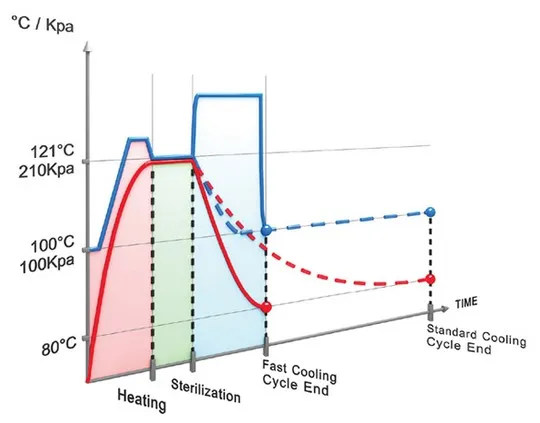
After the holding phase, liquids must cool before the door can open — and natural cooling is slow because of the same heat capacity that made come-up slow. Two acceleration strategies are common:
- Fast cooling circulates cooling through the chamber jacket while maintaining counter-pressure to prevent boil-over, reducing cooling time by up to about 75% compared with cooling under ambient conditions.
- Super-fast cooling adds fan-assisted air circulation around the containers, reducing cooling time by up to about 90%.
These figures describe two distinct features — fast cooling is not "90%." Counter-pressure during cooling is what makes fast cooling safe: it holds the liquid below boiling while heat is extracted. The cooling mechanisms are detailed in Laboratory Autoclave Features.
F₀ Control for Heat-Sensitive Liquid Media
Some media degrade if held at 121 °C for a full 15 minutes. F₀ control lets the autoclave deliver an equivalent, validated lethality at a lower temperature or shorter time by accumulating lethality continuously throughout the cycle.
F₀ is the equivalent exposure time in minutes at 121 °C, integrated across the actual load temperature:
F₀ = Σ 10^((T − 121) / z) × Δt, where T is the measured load temperature, z is the temperature change that alters lethality tenfold (conventionally z = 10 °C), and Δt is the measurement interval.
In practice the load probe feeds live temperature into this calculation, and the autoclave ends the holding phase when the target F₀ (for example, F₀ = 15) has accumulated — counting the lethal contribution of the come-up and cool-down, not just the time at peak temperature. The result protects heat-sensitive media while still proving the required lethality. F₀ is the liquid-load counterpart of the equivalence concepts discussed in autoclave validation: IQ/OQ/PQ.
Isothermal & Low-Temperature Cycles for Heat-Sensitive Media
Some lab work cannot use 121 °C at all. An isothermal cycle holds the load at a constant, lower temperature — typically in the 60 °C to 95 °C range — to process heat-sensitive materials gently. (Isothermal simply means "at constant temperature.") This is the canonical home for low-temperature processing in this guide; the solids and features guides link here rather than repeating it.
What isothermal cycles are used for:
- Agar and culture media — melting, holding, and gentle cooling without scorching or altering gel strength. A flexible isothermal cycle ramps up and cools down gently around the media's working temperature.
- Infant formula and similar heat-sensitive nutritional liquids.
- Thermoplastics such as LDPE that deform near standard sterilization temperatures.
- Inspissation of protein-rich media such as Lowenstein-Jensen or Loeffler slants (see below).
Important distinction — processing vs sterilization. A low-temperature isothermal hold at 60–95 °C does not, by itself, achieve the SAL 10⁻⁶ that a 121 °C/15-minute cycle delivers. At these temperatures the goal is usually gentle processing, pasteurization, or inspissation, or fractional approaches (heating on successive days) for specific media. When a true sterility assurance level is required, a validated 121 °C cycle — or an F₀-controlled cycle proving equivalent lethality — is the correct choice. Always match the cycle to whether the load must be sterilized or merely processed, and follow the media manufacturer's instructions.
Inspissation: Temperature and Use
Inspissation thickens and solidifies protein-rich media — for example Lowenstein-Jensen medium for mycobacteria and Loeffler serum medium — by gentle heating rather than by sterilizing them outright. It is typically carried out at around 80–85 °C, often for about 45 minutes, and for some media is repeated on successive days; higher temperatures make egg- and serum-based media bubble, discolor, or turn rubbery. An isothermal cycle, with the load probe in a representative tube or bottle, holds the media at the setpoint for the required time. Because inspissation does not achieve SAL 10⁻⁶, these media rely on aseptic preparation; always use the time and temperature given by the medium manufacturer or your reference method.
Container, Closure, and Fill Guidance
Liquid results depend as much on the container as on the cycle:
- Vent every container. Loosen caps or use vented closures so pressure equalizes; sealed bottles can implode on cooling or burst on heating.
- Leave headspace. Fill bottles to roughly two-thirds to allow for expansion and to reduce boil-over risk.
- Match container to slowest probe. Larger volumes need longer come-up; size the cycle to the largest container.
- Use autoclave-rated glass or polymer. Borosilicate glass and autoclave-rated polypropylene tolerate the cycle; check the temperature rating for any plastic.
- Group like volumes. A load of uniform container sizes heats and cools predictably; mixing 50 mL and 2 L bottles makes timing harder.
Media-Prep Applications
Liquid cycles and isothermal cycles together cover most media-prep work: sterilizing broths, buffers, and water at 121 °C; preparing and holding agar at working temperature; and processing heat-sensitive supplements with F₀ control. The relationship between temperature, pressure, and holding time underlying these cycles is explained in autoclave saturated steam temperature and pressure, and cycle selection across load types in autoclave cycle programs and time frames.
Standards
- ISO 17665 — moist-heat sterilization: validation and routine control, including liquid loads and the use of F₀ for lethality equivalence.
- EN 285 (large sterilizers) vs EN 13060 (small sterilizers) — a freestanding large-chamber liquid sterilizer is assessed under EN 285, a benchtop unit under EN 13060; both define liquid-cycle requirements relevant to lab work.
- AAMI guidance — best-practice reference for steam sterilization, including controlled cooling of liquids.
FAQ
Why can't I sterilize liquids on a normal autoclave cycle?
A standard solids cycle exhausts chamber pressure quickly at the end. For a liquid that is above 100 °C, a fast pressure drop causes violent flash-boiling (boil-over), spilling media and breaking containers. A liquid cycle releases pressure slowly so the liquid cools below its boiling point before pressure is lost.
How does F₀ control protect heat-sensitive media?
F₀ control accumulates lethality continuously based on the live load temperature, so the autoclave can deliver a validated equivalent of 121 °C exposure at a lower temperature or shorter hold. It counts the lethal effect of come-up and cool-down, not just peak time, which lets heat-sensitive media reach the required sterility assurance with less thermal damage.
Does an isothermal cycle sterilize?
Not on its own at 60–95 °C. A low-temperature isothermal hold is used for gentle processing, pasteurization, or inspissation of heat-sensitive media, not to reach SAL 10⁻⁶. When true sterilization is required, use a validated 121 °C cycle or an F₀-controlled cycle that proves equivalent lethality.
What temperature is used for inspissation?
Inspissation is typically carried out at about 80–85 °C, often for around 45 minutes, to solidify protein-rich media such as Lowenstein-Jensen without overheating them. It is a processing step, not sterilization, so follow the exact time and temperature from the medium manufacturer or your reference method.
How full should I fill bottles for liquid sterilization?
Fill to roughly two-thirds to leave headspace for expansion and to reduce boil-over risk, and always loosen caps or use vented closures so pressure can equalize. Size the holding time to the largest container in the load, since bigger volumes take longer to reach temperature.
What are the two temperature probes for in a liquid cycle?
The flexible load probes are placed inside a reference container so the cycle times the holding phase from the liquid's temperature, not the chamber's. Two probes provide cross-checking and redundancy, ensuring the holding phase begins only once the liquid itself reaches sterilization temperature.
Conclusion
Liquids sterilize themselves once they reach temperature, so a liquid cycle is defined by slow controlled exhaust, load-temperature probes, and — for fragile media — F₀ control and low-temperature isothermal cycles. Keep the distinction between sterilizing and gently processing clear, vent and fill containers correctly, and use fast cooling to recover turnaround. For equipment capabilities see Laboratory Autoclave Features; for dry loads see Sterilizing Solids and Hollows; to return to the section overview see Laboratory Autoclave Guide.