


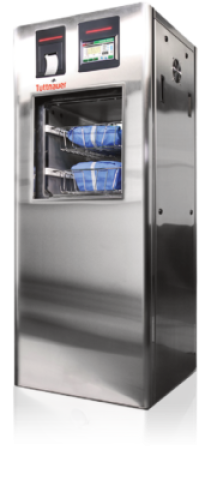
| Model | Normal Cycle (Non-hollow loads) | Advanced Cycle (Hollow loads) | Endoscope* |
|---|---|---|---|
| P50 | 35 min. | 40 min. | 32 min. |
| P110 | 39 min. | 44 min. | 37 min. |
| P160 | 43 min. | 48 min. | 41 min. |
| Test Cycles | Description |
|---|---|
| Test I | Penetration Test |
| Test II | Leakage Test |
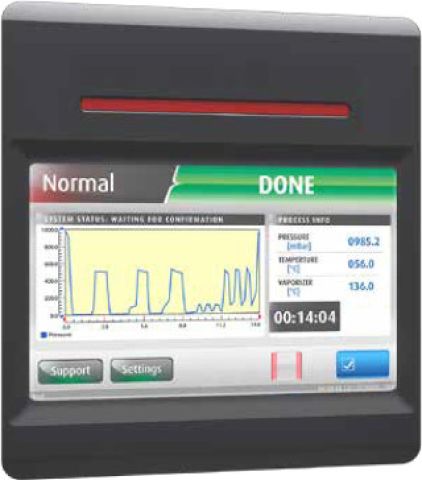
A bright multicolor LCD panel with multi-color display
- Multi-color display for easier reading from a distance
- Multilingual (26 languages)
- Dynamic graph displaying the chamber pressure and the cycle process
- Displays process info – pressure, temperature, vaporizer temperature.
Multiple access levels for added security
Generate PDF reports with graphs and tables using optional R.PC.R Software.
USB and Ethernet Ports
Thermal printer
Diagnostic In/Out test (enables technician to check each system component separately)
Tracking equipment and maintenance notifications
Equipment tracking software provides a detailed sterilization history of each endoscope tracked. The software will notify when equipment needs to be returned back to the original equipment manufacturer for maintenance.
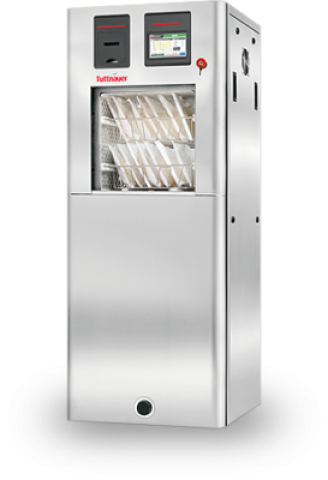
Chamber Volume
P50: 47 Liter
P110: 109 Liter
P160: 162 Liter
External Dimensions (WxHxD/D 2-doors) mm
P50: 702 x 1528 x 729 / 736 mm
P110: 702 x 1768 x729 / 736 mm
P160: 702 x 1768 x1029 / 1036 mm
No. of Baskets (WxD) mm
P50: 1 (399 x 599 mm)
P110: 2 (399 x 599 mm)
P160: 2 (399 x 899 mm)
Power (W) - Current (A)
P50: 3100 W - 13.5 A
P110: 4300 W - 18.7 A
P160: 4300 W - 18.7 A
Voltage (V) 3-Phase 50-60 Hz
P50: 230 V
P110: 230 V
P160: 230 V
Standards and Directives
• ISO 13485:2003
• ISO 14937
• EN 61010-2-040:2005
• EN 60601-1:2006/AC:2010
• CE Medical Device Mark 0344
1 - Cycle START
2 - Air removal from chamber > Preparation for diffusion > instruments exposed to H2O2 vapor
3 - Gas removal & breaking the H2O2 molecules > Preparation for diffusion > instruments exposed to H2O2 vapor
4 - Gas removal & breaking the H2O2 molecules > Aeration stage - removal of residue
5 - Cycle END

1 - Cycle START
2 - Air removal from chamber > Preparation for diffusion > instruments exposed to H2O2 vapor
3 - Gas removal & breaking the H2O2 molecules > Preparation for diffusion > instruments exposed to H2O2 vapor
4 - Gas removal & breaking the H2O2 molecules > Aeration stage - removal of residue
5 - Cycle END
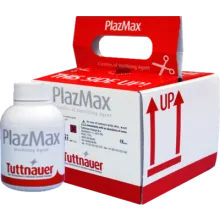

Process Challenge Device (PCD)
How can you be sure your hollow instruments have been 100% penetrated?Use the PCD kit to be sure your hollow instruments have been 100% penetrated.
Was this page helpful?
Specs, photos, documentation — tell us if anything is missing.
Thank you — your feedback is logged.