


BSL Autoclaves for Biosafety Sterilization
A BSL autoclave is a steam sterilizer engineered for the containment requirements of a biosafety-level laboratory. Beyond killing microorganisms, it must guarantee that nothing infectious escapes during the cycle — not through the chamber exhaust, not through the wall penetration where the autoclave is installed, and not in the liquid effluent that leaves the chamber. As the biosafety level rises from BSL-1 to BSL-4, those containment features become more demanding. This guide explains how BSL autoclaves differ from ordinary lab units: biosafety levels, bioshield framing, HEPA-filtered exhaust, effluent (thermal) decontamination, and pass-through installation.
For the underlying sterilization features shared with other lab units — cooling, drying, controls — see Laboratory Autoclave Features.
Hospital vs Laboratory Contamination Concerns
A hospital sterilizer and a lab BSL autoclave protect against opposite-facing risks. In a hospital, the goal is to make instruments sterile for the patient — keeping contamination out of a clean item. In a containment lab, the goal is to keep concentrated, sometimes exotic infectious agents in — decontaminating waste and equipment so that nothing harmful leaves the lab. A BSL autoclave is therefore as much a containment barrier as a sterilizer: it is frequently built into the containment wall and validated as part of the lab's primary or secondary barrier system.
Biosafety Levels (BSL 1–4)
Biosafety levels classify the containment required for work with biological agents, from BSL-1 (lowest risk) to BSL-4 (highest). The table below summarizes the framework defined by the CDC/NIH Biosafety in Microbiological and Biomedical Laboratories (BMBL) and the WHO Laboratory Biosafety Manual; consult those documents for authoritative requirements.
| Level | Agent risk | Example agents | Autoclave / containment role |
|---|---|---|---|
| BSL-1 | Not known to cause disease in healthy adults | Non-pathogenic E. coli | Standard microbiological practice; waste decontamination by autoclave |
| BSL-2 | Moderate-hazard agents causing human disease | Staphylococcus aureus, Salmonella, hepatitis viruses | On-site autoclave for waste; biosafety cabinet for aerosol-generating work |
| BSL-3 | Indigenous/exotic agents, serious disease, aerosol transmission | Mycobacterium tuberculosis, SARS-CoV-2 | Sealed wall penetration, directional airflow, often a pass-through autoclave; effluent control |
| BSL-4 | Dangerous/exotic agents, life-threatening, no vaccine or therapy | Ebola, Marburg viruses | Double-door pass-through autoclave as a primary barrier; full effluent decontamination; positive-pressure suit or Class III cabinet |
The Bioshield Frame
When an autoclave is installed through a containment wall — loaded from the lab side and unloaded from a clean corridor — the gap around the chamber is a potential leak path. A bioshield frame seals that penetration so the wall remains an intact containment barrier. Typical construction includes:
- A continuous, shock-absorbent neoprene seal between the autoclave and the wall opening
- Stainless-steel plates forming a cleanable, corrosion-resistant face
- A fully welded metal flange anchoring the assembly to the wall
- Threaded studs for secure, adjustable mounting
- Sealed electrical and service conduits so wiring penetrations do not breach containment
The result is a gas- and liquid-tight boundary that maintains the lab's pressure differential and prevents migration of contaminated air around the autoclave.
HEPA Filtration
Air leaving the chamber during vacuum and exhaust phases can carry aerosolized agents. A HEPA filter (high-efficiency particulate air) on the exhaust captures 99.97% of particles at 0.3 µm — the most penetrating particle size — so chamber air is filtered before release. In containment installations the filter housing is designed for safe, bag-in/bag-out change-out so staff are never exposed to the loaded filter. HEPA filtration on chamber exhaust is what allows a BSL autoclave to process infectious aerosol-generating loads without venting them to the room or the building exhaust unfiltered.
Effluent Decontamination for BSL Facilities
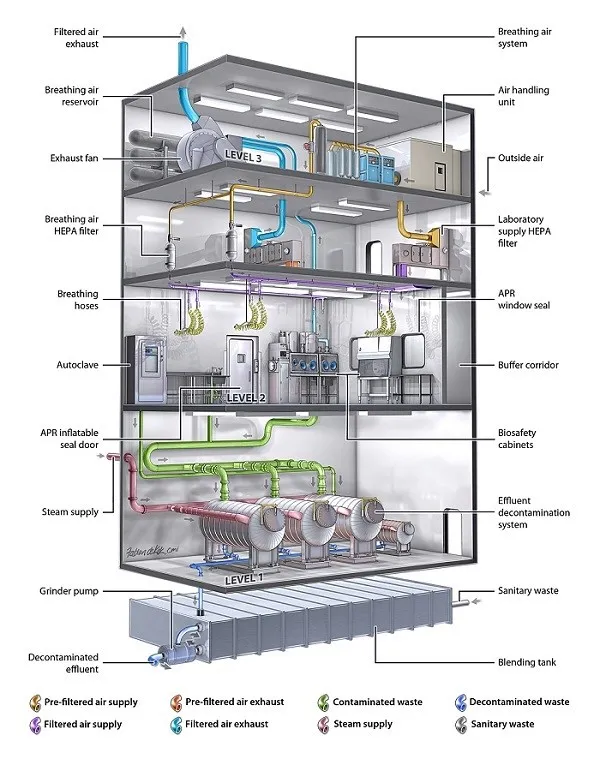
Solids and surfaces are handled by the steam cycle, but liquid effluent can carry live agents out of the chamber and into the building drain. Effluent decontamination is the liquid-side complement to chamber sterilization and HEPA-filtered exhaust: it makes sure that what goes down the drain has been treated as thoroughly as what comes out of the door.
Where Autoclave Effluent Comes From
- Condensate that forms as steam heats the chamber and load, and drains from the chamber during the cycle
- Liquid waste spilled from, or boiled out of, waste containers
- Vacuum-pump water, in units with a liquid-ring vacuum pump, because that water contacts the air and steam drawn out of the chamber
How Thermal Effluent Decontamination Works
- Integrated thermal biohazard system. The autoclave holds condensate in the chamber or a closed drain line and sterilizes it as part of the cycle. The drain stays closed until treatment is complete, so nothing leaves the unit untreated.
- Kill tank (effluent decontamination system). A dedicated vessel collects effluent from the autoclave, and often from sinks, showers, and floor drains elsewhere in the containment suite. It heats the batch to a validated time-and-temperature combination, holds it, cools it, and only then discharges it to the sanitary sewer.
Some facilities treat effluent chemically instead; thermal treatment avoids storing, dosing, and neutralizing disinfectants.
When It Is Required
At BSL-4, liquid effluent from the containment barrier — including the autoclave — must be decontaminated by a validated method before discharge. At BSL-3, the need is set by risk assessment, the agents handled, and national or local regulation; many BSL-3 facilities, and agricultural high-containment facilities, require it. At BSL-1 and BSL-2, effluent normally goes to the sanitary sewer under local discharge rules, because the load itself is decontaminated by the autoclave cycle. The CDC/NIH BMBL and the WHO Laboratory Biosafety Manual are the reference documents; your biosafety officer makes the final determination.
Validating Effluent Treatment
Treatment temperature and hold time are chosen for the agents handled and proven during commissioning, typically with biological challenges, then recorded batch by batch in routine use. Those records belong in the same containment documentation as the autoclave's cycle records. The drain connection itself is part of planning a lab autoclave installation, so effluent treatment is easiest to design in before the unit is installed rather than retrofitted.
Pass-Through (Double-Door) Configuration
A pass-through (double-door) autoclave has interlocked doors on opposite faces — one inside containment, one in the clean area. The interlock prevents both doors from opening at once, so material can only move from the contaminated side to the clean side after a completed, verified cycle. This makes the autoclave a directional barrier: waste and equipment cross the containment boundary only when decontaminated. Combined with the bioshield frame, the double-door design lets the autoclave function as part of the wall itself.
Other Considerations for BSL Labs
- Directional, controlled airflow. Containment labs maintain inward airflow; the autoclave installation must preserve, not disrupt, that pressure regime.
- Validation as a barrier. Beyond standard IQ/OQ/PQ, BSL autoclaves are commissioned and periodically requalified as containment equipment. See autoclave validation: IQ/OQ/PQ.
- Cleanability. Smooth, sealed, corrosion-resistant surfaces support decontamination of the unit's exterior.
- Documented cycles. Auditable records demonstrate that every load crossing the barrier was decontaminated; control-system documentation is covered in Laboratory Autoclave Features.
Standards and Guidance
- CDC/NIH BMBL — Biosafety in Microbiological and Biomedical Laboratories, the primary U.S. reference defining biosafety levels and containment practices.
- WHO Laboratory Biosafety Manual — international guidance on biosafety levels and containment.
- ISO 17665 — moist-heat sterilization validation and routine control for the sterilization cycle itself.
- EN 285 — large steam sterilizers, applicable to the freestanding pass-through units typical of containment labs.
- AAMI guidance — best-practice reference for steam sterilization and monitoring.
FAQ
What makes a BSL autoclave different from a standard lab autoclave?
A BSL autoclave adds containment features on top of normal sterilization: a bioshield frame to seal the wall penetration, HEPA-filtered chamber exhaust, effluent (thermal) decontamination for liquid waste, and a pass-through double-door design. These ensure infectious agents are contained and that nothing leaves the lab undecontaminated.
What is a bioshield frame?
A bioshield frame seals the gap between an autoclave and the containment wall it is installed through, keeping the wall an intact barrier. It typically uses a continuous neoprene seal, stainless-steel plates, a welded flange, threaded studs, and sealed service conduits to form a gas- and liquid-tight boundary.
Which biosafety levels require effluent decontamination?
Effluent decontamination is required at BSL-4, where no untreated liquid may leave containment. At BSL-3 it depends on risk assessment, the agents handled, and local regulation, and many facilities require it. A thermal effluent system or kill tank heats liquid waste to a validated time and temperature to inactivate agents before the effluent enters the drain.
Why do BSL autoclaves have two doors?
A pass-through (double-door) autoclave is loaded from inside containment and unloaded in the clean area, with an interlock that prevents both doors from opening at once. Material can only cross to the clean side after a completed, verified cycle, making the autoclave a directional containment barrier.
How effective is the HEPA filter on a BSL autoclave?
A HEPA filter captures 99.97% of particles at 0.3 µm, the most penetrating particle size, so aerosols generated during the cycle are removed from chamber exhaust before release. Containment units use safe-change (bag-in/bag-out) housings so staff are not exposed when filters are replaced.
Conclusion
A BSL autoclave is a containment barrier as much as a sterilizer. Its bioshield frame, HEPA-filtered exhaust, effluent decontamination, and pass-through design ensure infectious agents are inactivated and that nothing leaves the lab undecontaminated — with requirements scaling from BSL-1 through BSL-4. For the sterilization features these units share with other lab autoclaves, see Laboratory Autoclave Features; to return to the section overview, see Laboratory Autoclave Guide.