


Sterilizing Solids and Hollows in a Laboratory Autoclave
Sterilizing solids and hollows in a laboratory autoclave comes down to one thing: getting saturated steam into direct contact with every surface, including the inside of lumens and the depths of porous packs. Solid, non-porous items are the easy case — steam reaches their surfaces readily. Hollow and porous items are harder, because trapped air blocks steam and is the single most common cause of a failed lab cycle. This guide explains how to classify a load, why air removal is the central challenge, how to choose the right cycle, and how to load, dry, and validate solid and hollow loads.
For liquids and heat-sensitive media, see the Liquid Sterilization guide; this article covers dry, non-liquid loads.
What Counts as a Solid vs a Hollow Load
In the lab, "solids and hollows" spans a wide range of items, and the distinction that matters is how easily steam reaches every surface:
- Solid, non-porous items — forceps, spatulas, metal stands, solid glass rod. Steam contacts all surfaces directly.
- Hollow items — pipettes, pipette tips, tubing, flasks and bottles (empty), filter housings, hollow probes. Air must be evacuated from the lumen or cavity before steam can enter.
- Porous items — filters, fabric, cotton plugs, packed tip boxes, wrapped goods. Air is held throughout the material and resists simple displacement.
Hollow loads are sometimes subdivided into Type A (narrow, single-ended) and Type B (wider or open both ends) lumens, the classification used in small-sterilizer testing under EN 13060. Narrow, single-ended lumens are the hardest to sterilize because air is most easily trapped at the closed end.
Why Air Removal Is the Central Challenge
Air is the enemy of steam sterilization. Air pockets prevent steam from contacting the surface, and a surface that steam never touches is never sterilized — even if the chamber gauge shows the correct temperature. Residual air also lowers the local temperature relative to pure saturated steam at the same pressure.
For solid, non-porous items, gravity is usually enough: steam admitted at the top of the chamber displaces denser air downward and out through the drain. For hollow and porous loads, gravity displacement leaves air trapped inside lumens and within porous material, so active air removal is required.
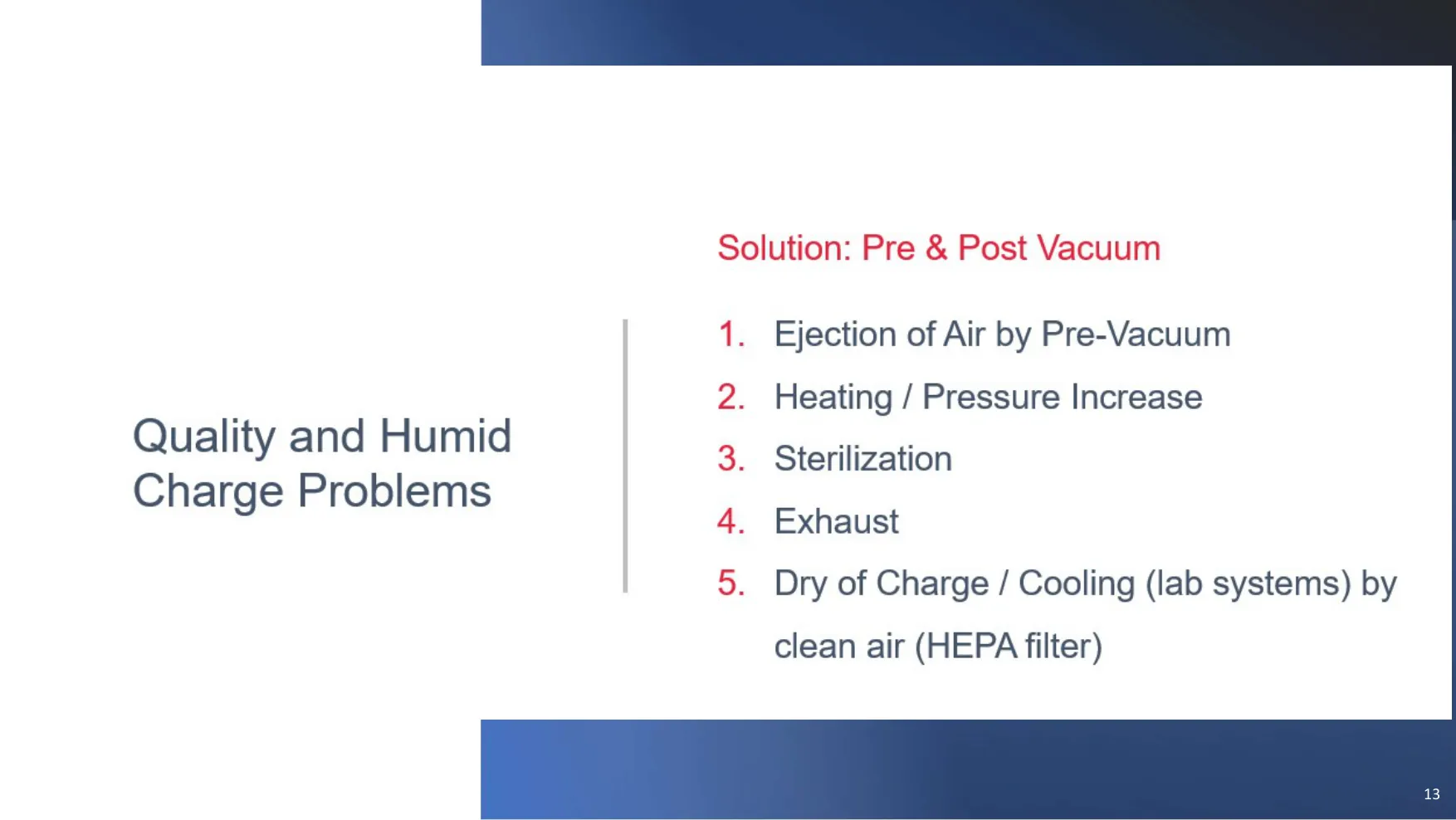
A fractionated pre-vacuum cycle solves this with a series of vacuum and steam pulses before the holding phase. A vacuum pump evacuates the chamber and load, steam is admitted, and the sequence repeats — each pulse diluting and removing more trapped air. Effective vacuum systems remove well over 99% of the air in the chamber, allowing steam to penetrate lumens and porous packs that a gravity cycle cannot reach. The mechanics of vacuum-assisted air and moisture removal are covered in the Laboratory Autoclave Features guide.
Choosing the Right Cycle
| Load | Recommended cycle | Why |
|---|---|---|
| Solid, non-porous instruments and glass | Gravity displacement | Steam reaches all surfaces; air falls away by gravity |
| Hollow items (pipettes, tubing, flasks) | Pre-vacuum (fractionated) | Active evacuation clears air from lumens |
| Porous items (filters, fabric, packed boxes) | Pre-vacuum (fractionated) | Air is held throughout the material |
| Mixed solid + hollow load | Pre-vacuum (fractionated) | Safest choice covers the hardest item present |
Typical exposure is 121 °C for 15–30 minutes or 134 °C for 3–10 minutes, with the longer times for denser or wrapped loads; always follow the cycle defined for your load and confirmed by validation. Heat-sensitive items that cannot tolerate these temperatures belong in a low-temperature isothermal cycle rather than a standard solids cycle.
Loading Solids and Hollows Correctly
Even a correctly chosen cycle fails if the load blocks steam or traps condensate. Core practices:
- Orient hollows to drain. Place bottles, flasks, and tubing on their side or inverted so air can escape and condensate can run out, not pool inside.
- Loosen closures. Caps and lids must be loosened so the chamber pressure and the container interior can equalize; sealed containers prevent steam entry and can deform or burst.
- Avoid overpacking. Leave space between items so steam circulates freely. A tightly packed chamber creates cold spots and air traps.
- Use trays and racks, not stacks. Nesting items (stacked beakers, packed tip boxes pressed together) creates cavities air cannot leave.
- Keep porous and solid items separated where possible so a porous item does not shadow a metal surface from steam.
General principles of chamber loading apply here too; see how to load an autoclave.
Drying the Load
Wet glassware and packs are a problem: residual moisture can recontaminate porous wraps during storage and leaves water spots on glassware. After the holding phase, a post-cycle vacuum (active drying) pulls moisture out of the chamber and load by lowering the boiling point so residual water flashes to vapor and is evacuated. Porous loads and wrapped items especially benefit from active drying; solid glassware may need only a brief dry stage. Inadequate drying is a frequent cause of wet packs — see troubleshooting sterilization failures.
Validation and Routine Monitoring
Air removal must be verified, not assumed:
- Bowie-Dick test — a daily air-removal/steam-penetration check for pre-vacuum cycles, confirming the vacuum system clears air uniformly.
- Helix / process challenge device (PCD) — challenges steam penetration into a narrow lumen, the relevant test for hollow loads. See process challenge devices, Bowie-Dick & Helix tests.
- Biological indicators — spores of Geobacillus stearothermophilus confirm lethality for the load.
- Chemical indicators — placed inside and outside packs to flag steam exposure.
Formal qualification of the autoclave itself (installation, operation, and performance qualification) is covered in autoclave validation: IQ/OQ/PQ.
Standards
- ISO 17665 — moist-heat sterilization: development, validation, and routine control. The governing standard for steam sterilization of solid and porous loads.
- EN 285 (large sterilizers) and EN 13060 (small sterilizers) — the distinction matters for lab units: a large freestanding chamber is assessed under EN 285, while a benchtop unit is assessed under EN 13060, which also defines the hollow-load (Type A/B) and porous-load test cycles.
- AAMI guidance (e.g., ANSI/AAMI ST79) — widely used best-practice reference for steam sterilization and monitoring.
FAQ
Why do hollow items fail to sterilize in a gravity cycle?
Hollow items trap air inside their lumens, and gravity displacement cannot pull that air out. Steam stops at the air pocket and never contacts the inner surface, so it is not sterilized. A fractionated pre-vacuum cycle actively evacuates the air first, which is why hollow and porous loads require it.
What temperature and time should I use for glassware and hollow loads?
Standard exposure is 121 °C for 15–30 minutes or 134 °C for 3–10 minutes, with longer times for denser or wrapped loads. The exact parameters should come from the cycle validated for your specific load rather than a generic figure.
Should bottle and flask caps be tightened before autoclaving?
No. Caps and lids must be loosened so pressure equalizes and steam can enter; tightly sealed containers block sterilization and can deform or burst. Tighten closures only after the load has cooled and been removed.
Why is my glassware coming out wet?
Wet glassware usually indicates inadequate drying or condensate pooling inside containers. Orient hollows to drain, avoid overpacking, and ensure the cycle includes an adequate post-cycle vacuum (active drying) stage. Persistent wet loads point to a drying or steam-quality problem covered in the troubleshooting guide.
Conclusion
Solid loads sterilize easily; hollows and porous items do not, because trapped air blocks steam. Match the load to a gravity or pre-vacuum cycle, load so air can escape and condensate can drain, dry adequately, and verify air removal with Bowie-Dick, Helix/PCD, and biological indicators. For heat-sensitive items and liquids, move to the Liquid Sterilization guide; to compare equipment capabilities, see Laboratory Autoclave Features.